
A local commercial move in the U.S. typically runs within standard industry cost ranges, while long-distance or complex relocations can cost significantly more. The single factor that drives that number higher than anything else isn't square footage or distance. It's operational continuity — how much planning, phasing, and specialized labor it takes to keep your business running during the move. Get that wrong and the mover's invoice becomes the smallest line item on your total cost.
Quick-reference cost ranges (copy these into your budget spreadsheet):
- Small office, local: $1,500–$5,000
- Medium office, local: $5,000–$20,000
- Large office, local: $20,000+ (depending on complexity)
- Any size, long-distance: $10,000–$30,000+ (depends on mileage & complexity)
When you call for a first quote, ask for three things immediately: an itemized estimate (not a ballpark), guaranteed scheduling windows, and a Certificate of Insurance (COI) naming your building. If a mover hesitates on any of those, move on.
Table of Contents
- What do commercial moving costs actually include?
- What are the major cost drivers for a commercial move?
- How much does a commercial move cost by business size?
- What hidden fees and broker traps should you watch for?
- How do you budget and control costs without sacrificing uptime?
- How do you vet and choose a commercial mover?
- Why does operational continuity often cost more — and is it worth it?
- What permits and compliance costs should you plan for?
- Key Takeaways
- Why flat-rate pricing changes the commercial moving conversation
- Get a written commercial moving estimate before you finalize your budget
- Useful sources and official guidance for planning a commercial move
What do commercial moving costs actually include?
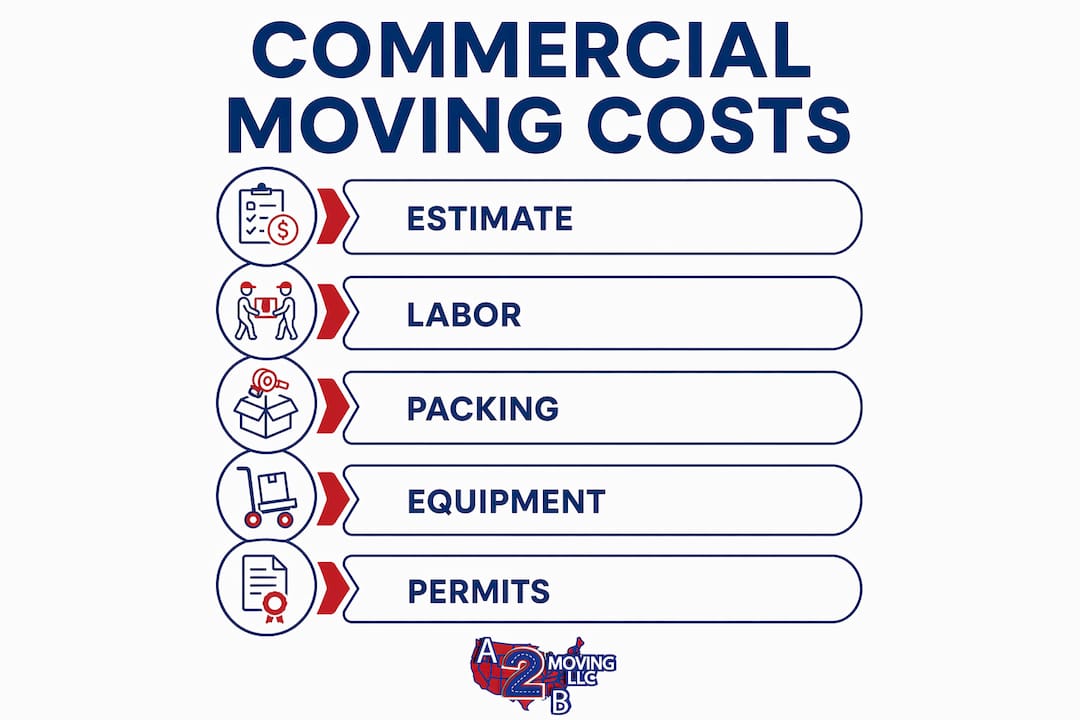
Hourly labor is usually the largest single line item on a local commercial invoice, but a complete quote covers far more. Knowing each component lets you compare bids on equal footing instead of chasing the lowest bottom line.

| Line Item | What It Covers | Typically Included or Optional? |
|---|---|---|
| Labor (crew hours) | Movers' time loading, carrying, unloading | Included |
| Truck and travel time | Vehicle fee plus drive time between locations | Included |
| Fuel surcharge | Mileage-based fuel cost | Sometimes separate |
| Packing materials | Boxes, wrap, tape, wardrobe boxes | Optional (add-on) |
| Packing labor | Crew time to pack and unpack contents | Optional (add-on) |
| Disassembly / reassembly | Workstations, shelving, conference tables | Often optional |
| IT / specialty handling | Servers, AV equipment, lab instruments | Separate quote required |
| Storage-in-transit | Short-term warehouse between locations | Optional (add-on) |
| Insurance / valuation | Basic released-value or full-value protection | Basic included; full-value optional |
| Permits and reservations | Loading dock, freight elevator, parking | Situational |
A few items deserve extra attention. Packing labor is almost always quoted separately, and businesses that skip it often underestimate how long staff packing takes. Disassembly and reassembly of modular workstations can add several hours of crew time. IT and server handling is rarely covered under a standard hourly rate. Budget it as a separate line from the start.
What are the major cost drivers for a commercial move?
Operational complexity shapes the final price more than raw volume. Two offices with identical square footage can produce quotes that differ by thousands of dollars because of how they need to be moved, not just what needs to move.
Here are the primary drivers, roughly in order of impact:
- Operational continuity and phasing. A department-by-department cutover, overnight moves, or parallel operations at two sites all require more planning hours and often premium labor rates.
- Labor hours and crew size. More movers finish faster but cost more per hour. Fewer movers cost less per hour but extend the job, which can mean more total labor cost if the building has tight access windows.
- Building access and loading constraints. A shared freight elevator with a two-hour reservation window, a loading dock that closes at 4 PM, or a high-rise with security check-in can turn a four-hour job into an eight-hour one. Access-related delays can push decommissioning costs to several times the physical move cost if not planned early.
- IT and specialized equipment. Servers, lab instruments, and modular workstations require certified handling and separate insurance. General crews are not equipped for this.
- Distance and mileage. Local moves are billed hourly. Long-distance moves shift to weight-and-mileage pricing, which changes the math entirely.
- Timing and after-hours premiums. Weekend and overnight moves carry a 20–30% labor premium but frequently reduce total business cost when you factor in lost productivity.
- Packing and materials. Full professional packing can nearly double labor cost. Partial packing (fragile items only) adds a smaller but real amount.
Pro Tip: Paying a premium for weekend or overnight moves may reduce overall business cost by minimizing lost productivity. Consider your specific situation before choosing a move time.
How much does a commercial move cost by business size?
Same square footage can produce very different quotes depending on operational needs and building constraints, so the scenarios below are starting points, not guarantees. What pushes a scenario toward the high end is almost always complexity, not size alone.
| Scenario | Estimated Range | Key Variables |
|---|---|---|
| Small office, 5–15 employees, local | $1,500–$5,000 | Few workstations, standard access, minimal IT |
| Medium office, 20–75 employees, local | $5,000–$20,000 | Phased move, modular furniture, IT handling |
| Large office, local | $20,000+ (depending on complexity) | Multi-day, specialty equipment, permits |
| Any size, long-distance | $10,000–$30,000+ (depends on mileage & complexity) | Weight, mileage, complexity |
Quick math examples:
- Small office, local: A 3-person crew at $150/hour (crew rate, not per mover) working 8 hours = $1,200 in labor. Add truck, fuel, and basic materials and you're at $1,800–$2,200 for a clean move with good building access.
- Medium office, local: A 5-person crew at $250/hour working 2 days (16 hours) = $4,000 in labor. Add packing labor, disassembly, IT handling, and permits and the total lands in the $8,000–$14,000 range.
- Large office, long-distance: Weight-and-mileage pricing takes over. A 10,000-square-foot office moving 500 miles with IT and specialty handling can easily reach $25,000–$40,000 once project management and storage-in-transit are included.
Industry-specific callouts:
- Medical and dental offices carry additional costs for biohazard-compliant packing and equipment recalibration after the move.
- Law firms and financial offices often require chain-of-custody documentation for file transport.
- Tech companies with server rooms should budget IT migration as a completely separate project with its own vendor.
What hidden fees and broker traps should you watch for?
The estimate looks clean. Then moving day arrives. Extra fees that never appeared in the original quote show up on the final invoice, and by that point your furniture is on the truck.
Common extra charges to ask about before you sign:
- Stair fees: Charged per flight, often $75–$200 per flight at both origin and destination.
- Long-carry fees: When the truck cannot park within roughly 75 feet of the entrance, movers charge for the extra walking distance.
- Elevator reservation fees: Padding, scheduling, and waiting time for freight elevators are often billed separately.
- Waiting time / standby charges: If your new space isn't ready or building access is delayed, the crew clock keeps running.
- Shuttle fees: When a full-size truck can't reach your building, a smaller shuttle vehicle is dispatched. That's a separate charge.
- Fuel surcharges: Sometimes buried in the fine print rather than listed as a line item.
- Storage-in-transit: If delivery is delayed, short-term warehouse storage accrues daily.
- Third-party subcontractor fees: Some brokers pass your job to a carrier and mark up the price without disclosing it.
The broker vs. carrier problem. A moving broker arranges the job but does not perform it. The actual work goes to a carrier, sometimes one you've never vetted. Brokers are legal, but the markup and the accountability gap are real risks. Before signing anything, ask: "Are you the carrier performing this move?" Then verify the carrier's USDOT and MC numbers at FMCSA.gov and request a COI directly from the carrier, not the broker.
Contract language to avoid:
- Avoid contract clauses with unlimited estimated charges
- Watch vague language or undefined fees
- Ensure clear inventory and scope definitions
How do you budget and control costs without sacrificing uptime?
The goal isn't to find the cheapest mover. It's to minimize the total cost to your business, which includes the invoice, the downtime, and the productivity loss. Those last two often exceed the first.
Phasing strategy:
- Map your departments by interdependency. Move the least operationally critical teams first.
- Keep IT, reception, and client-facing functions running at the old location until the new space is fully set up.
- Run a parallel-operations window of at least 48 hours if your budget allows. The overlap cost is usually less than a full-day shutdown.
- Confirm with your mover that phased moves are priced per phase, not as a single job with arbitrary add-ons.
In-house prep that saves real money:
- Have staff pack personal desk items in labeled boxes before the crew arrives. One hour of crew time saved per employee adds up fast.
- Purge unused furniture, outdated equipment, and excess inventory before the move date. Movers charge by volume and time, not sentiment.
- Label every box, cable, and piece of furniture with its destination room before the crew arrives. Reassembly confusion is billed labor.
- Coordinate IT vendor access separately so the moving crew isn't waiting on a network tech.
When professional packing is worth it:
- Conference rooms with AV equipment and complex cable runs
- Reception areas with branded displays or fragile décor
- Any space with items that carry replacement costs higher than the packing labor fee
Negotiation checklist:
- Always request an itemized, binding estimate. A non-binding estimate is a starting point, not a contract.
- Compare flat-rate vs. hourly pricing. Flat-rate protects you from scope creep; hourly can be cheaper for a simple, fast move.
- Bundle packing services with the move when possible. Bundled pricing is almost always lower than two separate quotes.
- Schedule off-peak when feasible (mid-week, mid-month, October through February).
- Set a contingency line of 10–15% of your total estimate for surprises. Not every building access issue is predictable.
How do you vet and choose a commercial mover?
The lowest bid is rarely the best value. A mover who underestimates the job, lacks proper insurance, or subcontracts without disclosure creates costs that dwarf any savings on the invoice.
Questions to ask every mover you're considering:
- Are you the carrier performing this move, or are you a broker?
- What is your USDOT number and MC number? (Verify both at FMCSA.gov.)
- What insurance do you carry, and can you provide a COI naming our building?
- How many commercial moves of similar size have you completed in the past 12 months?
- How do you handle IT equipment and server rooms?
- Do you use subcontractors? If so, are they covered under your COI?
- What are your guaranteed scheduling windows, and what happens if you miss them?
Trust signals to expect on a credible proposal:
- Itemized, binding estimate with labor, truck, materials, and special handling broken out separately
- COI available on request, naming your building as additionally insured
- References or a portfolio of comparable commercial moves
- Firm scheduling windows in writing, not "we'll do our best"
- Written exclusions that define what the quote does not cover
Red flags that should stop the conversation:
- Refusal to provide USDOT/MC numbers or COI
- Large upfront deposit (more than 10–20%) required before a contract is signed
- Scope described in vague terms with no written inventory or exclusions
- The mover can only tell you about the broker, not the carrier who will show up
- No references for commercial work, only residential
A detailed, itemized estimate that breaks out labor, trucks, packing materials, disassembly, reassembly, and project coordination helps ensure clear understanding between you and the mover.

Why does operational continuity often cost more — and is it worth it?
The primary driver of commercial moving cost is not the number of desks or the distance between buildings. It's the planning and sequencing required to keep your business running while the move happens. That's what separates a commercial quote from a residential one.
Consider the math. Daily productivity value during move-related downtime can be substantial. A weekend move that carries a labor premium might add to the invoice but could save money compared to lost productivity. The arithmetic is straightforward.
A practical example (A2bmoving-style scenario):
A 25-person professional services firm in the Ohio Valley needed to relocate to a new floor in the same building. A weekday move during business hours would have cost less in labor but required a full-day shutdown. Instead, the firm scheduled a Friday evening through Saturday move with a slightly larger crew. The labor premium added roughly $600 to the invoice. The firm avoided a full day of lost billable hours and was fully operational Monday morning.
When the premium is worth it:
- Your team bills by the hour or by the project, and a single lost day costs more than the labor premium
- Client-facing operations cannot be interrupted without reputational risk
- IT infrastructure requires a clean cutover window rather than a rolling migration
Pro Tip: Ask your mover to quote both a weekday and a weekend/evening scenario side by side. Then calculate your own productivity cost using your average revenue per employee per day. The comparison usually makes the decision obvious.
IT and specialized equipment should always be scoped separately. General moving crews are not trained or insured for server migration, and a data loss event during a move creates costs that no moving invoice can cover.
What permits and compliance costs should you plan for?
Permit and compliance costs are easy to overlook in an early budget, but they can delay your move or trigger fines if you skip them.
Pre-move compliance checklist:
- Building move-in/move-out rules: Confirm freight elevator reservation windows, loading dock hours, and any required building damage deposits with both your current and new landlord before booking your mover.
- Certificate of Insurance (COI): Most managed commercial buildings require the moving company to file a COI naming the building as additionally insured. Arrange this 3–5 business days before the move date.
- Parking and loading zone permits: In urban areas, a street loading zone permit may be required for the moving truck. Costs vary by city. Skipping this can result in fines or a truck that can't park near your entrance.
- Elevator padding and reservation fees: Many buildings charge a fee to pad and reserve the freight elevator. Confirm this with building management and add it to your budget.
- Lease decommissioning requirements: Your outgoing lease may require you to restore the space to original condition. Building-access restrictions and decommissioning obligations can cost several times more than the physical move if not identified early.
- Signage and directory updates: Some buildings charge administrative fees to update lobby directories and suite signage.
- Business license address update: Notify your state and local licensing authorities of your new address. Some jurisdictions charge a small amendment fee.
- USPS and vendor address changes: Not a permit, but a compliance task with real operational consequences if delayed.
Verify lease terms and building rules before you finalize your move date. A freight elevator that's only available 8 AM–12 PM on weekdays can reshape your entire schedule and your budget.
Key Takeaways
Commercial moving costs are influenced significantly by operational complexity and continuity planning in addition to square footage and distance.
| Point | Details |
|---|---|
| Budget for downtime, not just the invoice | Lost productivity per employee per day often exceeds the mover's fee for mid-size offices. |
| Insist on itemized, binding estimates | A detailed proposal breaking out labor, truck, materials, and special handling is the clearest sign of a qualified mover. |
| Verify building rules early | Freight elevator windows, COI requirements, and decommissioning obligations can reshape your schedule and add significant cost. |
| Budget IT separately | Servers and specialized equipment require certified crews and separate insurance; never assume they're covered under a standard hourly rate. |
| A2bmoving for Ohio Valley businesses | A2bmoving offers flat-rate commercial moving with licensed, insured crews and transparent pricing for businesses in the Wheeling, WV area. |
Why flat-rate pricing changes the commercial moving conversation
Most of the cost anxiety around business relocation comes from one place: not knowing what the final invoice will say. Hourly billing with vague scope language is how a $6,000 estimate becomes a $9,500 bill. A2bmoving's approach to commercial moving in the Wheeling, WV area is built around flat-rate pricing precisely because business owners need a number they can put in a budget, not a range that shifts on moving day.
With over six years of experience handling commercial and office relocations in the Ohio Valley, A2bmoving brings fully licensed and insured crews to every job. The team handles workstation disassembly and reassembly, careful furniture protection, and the kind of scheduling flexibility that lets businesses move over a weekend and open Monday without drama. That's not a marketing claim — it's the operational reality that flat-rate, transparent pricing makes possible.
Get a written commercial moving estimate before you finalize your budget

A2bmoving provides free, itemized commercial moving estimates for businesses in the Wheeling, WV area and throughout the Ohio Valley. Every quote includes guaranteed scheduling windows, COI documentation, and a written scope so you know exactly what's covered before anyone lifts a box.
The fastest way to get an accurate number is a brief walkthrough or a detailed inventory call. Prepare a rough floor plan, a list of specialty items (IT equipment, safes, large furniture), and your target move dates. That's all it takes to get a flat-rate quote you can actually use in a budget.
Ready to plan your office relocation? Visit A2bmoving's office moving services page or request a quote directly at a2bmoving.info/services.
Useful sources and official guidance for planning a commercial move
These are the primary sources used to build this guide. Each one is worth bookmarking for your own planning process.
- FMCSA.gov — The Federal Motor Carrier Safety Administration's carrier lookup tool. Use it to verify any mover's USDOT and MC numbers before signing a contract. This is the single most important verification step.
- Move Solutions (movesolutions.com) — Industry commentary on commercial moving cost breakdowns, including local vs. long-distance ranges and operational complexity factors.
- US MPO (usmpo.org) — Move-impact analysis used to calculate productivity cost during business relocations. Useful for justifying off-hours or phased move premiums to stakeholders.
- Moving.com cost calculator — Lists common extra fees (stair, long-carry, elevator, shuttle, fuel surcharge) as additive line items. Good for auditing a quote against industry norms.
- Recon Furniture (reconfurniture.com) — Industry perspective on building-access constraints and decommissioning costs. Relevant for understanding how freight elevator scheduling and lease obligations affect total relocation cost.
- A2bmoving commercial moving page — A2bmoving's service detail for commercial and office relocations in the Wheeling, WV area, including flat-rate pricing information and contact options.