
Flat rate moving gives you a single, binding price for your entire move. Once you sign the contract and fully disclose your inventory, that number doesn't change. For large homes, long-distance relocations, or any move where time is genuinely hard to predict, a flat fee beats hourly pricing almost every time.
The short version: Get a binding written estimate after an in-home or virtual survey. Disclose everything — specialty items, stairs, long carries, extra stops. That one step is what separates a smooth move from a billing nightmare.
When flat rate makes the most sense:
- Large homes (3+ bedrooms) where move time is unpredictable
- Long-distance moves where hourly billing would be impossible to cap
- Complex jobs with specialty items like pianos, safes, or antiques
- Anyone who needs a firm number for budgeting before moving day
Table of Contents
- How does flat rate moving actually work?
- Pros and cons of flat rate pricing
- Flat rate vs. hourly: which one fits your move?
- What should a written flat-rate estimate include?
- How to get an accurate flat-rate quote
- What does flat rate moving typically cost in the U.S.?
- How to avoid surprise charges on moving day
- How A2bmoving handles flat-rate moves
- Key Takeaways
- Why transparent pricing is the only kind worth trusting
- Get a binding flat-rate quote from A2bmoving
- Useful sources
How does flat rate moving actually work?
A flat-rate moving quote is a binding total price that locks in your cost once you sign the contract, provided you fully disclose the scope of the move. The mover calculates that price based on several factors: the estimated weight or volume of your belongings, the distance between origin and destination, access conditions at both addresses, and any specialty items requiring extra handling.
What's typically included in the base price:
- Labor for the full crew
- Transportation and fuel
- Basic moving equipment (dollies, blankets, straps)
- Loading and unloading
What's often excluded (and must be quoted separately):
- Packing materials and packing labor
- Furniture disassembly and reassembly
- Specialty item handling (pianos, safes, pool tables)
- Long-carry fees if the truck can't park close
- Storage if the destination isn't ready
The quoting process usually follows one of three paths. An estimator visits your home in person, walks every room, and measures access points. A virtual survey works the same way over video. Some companies offer package-based instant pricing for straightforward moves. Of these, the in-home or virtual survey produces the most accurate binding quote because the estimator actually sees your volume and access conditions.
A binding estimate is not a ballpark. It's a contract. The price on that paper is the price you pay, assuming you disclosed everything accurately.
Pro Tip: During a virtual survey, start each room from the doorway and pan slowly. Call out specialty items by name ("upright piano in the living room," "gun safe in the office"). Estimators can't price what they can't see, and surprises on moving day almost always trace back to items that weren't mentioned during the survey.
Pros and cons of flat rate pricing

| Factor | Flat Rate | Hourly |
|---|---|---|
| Price certainty | Fixed before moving day | Depends on actual time |
| Best for | Large or long-distance moves | Small, quick local moves |
| Risk of overcharge | Low (binding contract) | Higher if move runs long |
| Risk of overpaying | Possible on fast small moves | Lower for efficient short jobs |
| Accuracy requirement | High (full disclosure needed) | Lower |
| Scam protection | Strong with written contract | Varies |

The case for flat rate:
A binding flat-rate quote acts like insurance: you may pay slightly more than the cheapest possible hourly outcome, but you're protected if the move runs long. Traffic, elevator waits, a tricky staircase — none of those add to your bill. For long-distance and large household moves, flat-rate pricing offers predictable final costs even when time estimates are genuinely uncertain.
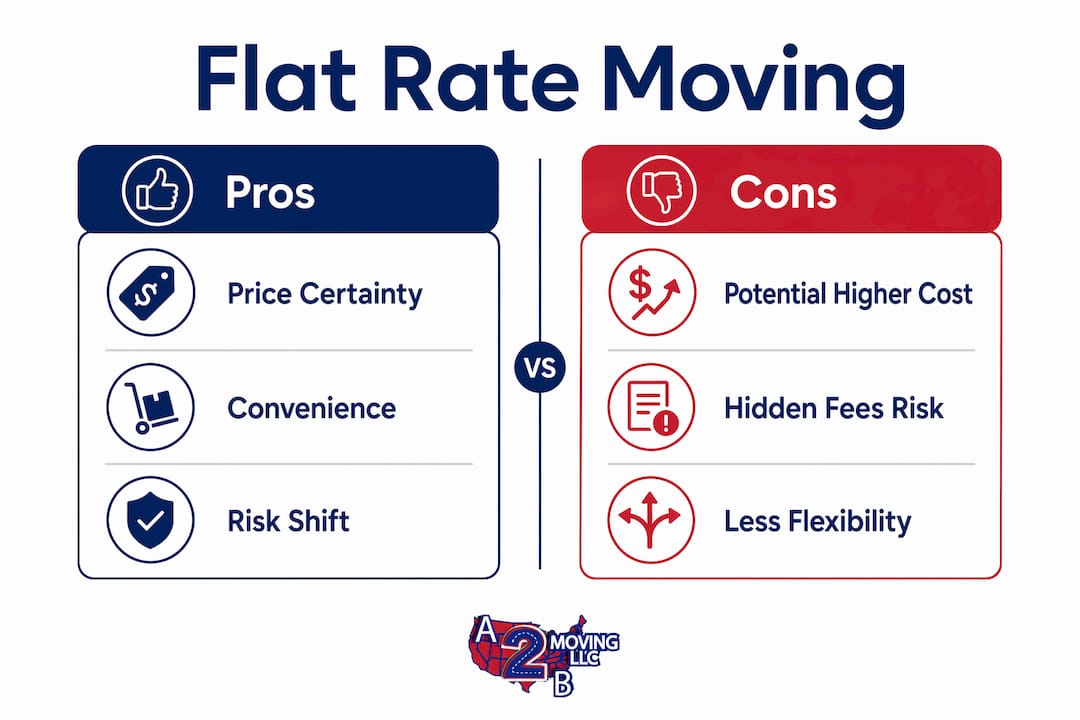
Where flat rate can cost you more:
For small, short-distance local moves, hourly pricing can be cheaper than flat rate. A flat-rate quote factors in potential delays, so for a studio apartment moving ten blocks, you might pay a premium for certainty you didn't need. The math only favors flat rate when the move is complex enough that time overruns are a real possibility.
The trust risk is real too. Some companies advertise flat-rate pricing but bury additional fees in vague contract language. A legitimate binding estimate prevents that — which is exactly why the written contract matters more than any verbal promise.
Flat rate vs. hourly: which one fits your move?
The simple rule: flat rate favors volume and distance; hourly favors speed and simplicity.
- Studio or 1BR, same city, under 10 miles. Hourly almost always wins. A two-person crew can finish in 3–4 hours, and you pay only for actual time.
- 2BR apartment with stairs, 30+ miles. This is the gray zone. Get both types of quotes and compare scope carefully.
- 3–4BR house, any distance over 50 miles. Flat rate. Time is too unpredictable, and a long-distance hourly bill can spiral.
- Any move with specialty items. Flat rate, because specialty handling adds unpredictable time.
- Office or commercial move with multiple floors. Flat rate. Building access windows and elevator scheduling make hourly billing unreliable.
| Move Type | Distance | Complexity | Recommended Pricing |
|---|---|---|---|
| Studio or 1BR | Local (under 20 mi) | Low | Hourly |
| 2BR | Local or regional | Moderate | Either — compare quotes |
| 3–4BR | Any | Moderate to high | Flat rate |
| Long-distance | 50+ miles | Any | Flat rate |
| Specialty items | Any | High | Flat rate |
| Office/commercial | Any | High | Flat rate |
The long-distance norm is flat rate, often combined with weight-based components or carrier minimums. Interstate movers are federally regulated and typically quote binding or not-to-exceed estimates rather than open-ended hourly rates.
What should a written flat-rate estimate include?
A complete, trustworthy estimate covers more than just the total price. Before you sign anything, confirm these items are present:
Required line items:
- Total binding price (stated explicitly as "binding")
- Full scope of work: rooms, items, services included
- List of excluded services and their separate pricing
- Origin and destination addresses
- Scheduled survey date and move date
- Cancellation and rescheduling terms, including deposit refund policy
Trust signals to verify:
- DOT number and MC number for interstate moves (verify at fmcsa.dot.gov)
- Proof of liability insurance and cargo coverage
- Bill of lading (your legal contract for the move)
- Clear schedule of any potential extra fees
Red flags that should stop you cold:
- "Binding" language that's vague or qualified with exceptions not tied to your disclosure
- No written estimate at all — verbal-only quotes
- Pressure to pay a large cash deposit before the survey
- Evasive answers when you ask about additional fees
- No DOT or MC number for an interstate move
Moving scams often advertise flat-rate pricing but add hidden fees at delivery. The written contract is your protection. If a company won't put the full scope in writing before you book, walk away.
Pro Tip: Ask specifically: "Is this a binding estimate, and under what conditions could the price change?" A legitimate mover will give you a clear, direct answer. Hedging or deflection is a warning sign.
How to get an accurate flat-rate quote
Preparation before the survey is what separates a clean binding quote from one that falls apart on moving day.
- Inventory room by room. Walk every space and list every item, including garage, attic, basement, and outdoor furniture. Don't skip the small stuff — boxes add up fast.
- Photograph large and specialty items. A photo of your sectional sofa, piano, or gun safe gives the estimator exact dimensions without guesswork.
- Measure critical access points. Doorways, hallways, stairwells, and elevator dimensions at both addresses. A sofa that won't fit through a door becomes a disassembly charge.
- Document parking and building rules. HOA restrictions, loading dock hours, elevator reservation windows, and COI requirements all affect the quote.
- List every stop. If the truck is making an additional pickup or drop-off, disclose it upfront.
- Note anything that requires special handling. Pianos, safes, artwork, antiques, and large appliances all change the price.
For a virtual survey, start each room from the doorway and pan slowly so the estimator gets a clear sense of volume. Label specialty items aloud as you pass them.
Questions to ask your estimator:
- What's included in the base price, and what's billed separately?
- How do you handle items discovered on moving day that weren't on the inventory?
- What's your cancellation and rescheduling policy, and is my deposit refundable?
- Are your crews employees or subcontractors?
Compare multiple quotes before booking — and compare the written scope of work, not just the totals. Two quotes at the same price can cover very different things. Scope differences are the most common source of price surprises, so read every line item before you sign.
Disclosure items that change your price:
- Undisclosed pianos or safes
- Long carries (truck can't park within a standard distance)
- Narrow staircases or no elevator access
- Additional stops not mentioned during the survey
- Items added to the load after the estimate is signed
What does flat rate moving typically cost in the U.S.?
Flat-rate pricing varies by region, move size, and distance. The ranges below reflect typical U.S. market conditions and are meant to help you spot outliers, not to predict your exact quote.
Typical local flat-rate ranges:
- Studio or 1BR: typically priced for local moves as transparent flat-rate packages from experienced NYC movers
- 2BR: commonly available as flat-rate packages from NYC moving professionals, prices vary by specifics
- 3–4BR: offered as flat-rate moves reflecting volume and access complexity, with pricing set by each mover
- Long-distance moves: typically priced starting from baseline package rates that increase with distance and load weight
These are general reference points. Your actual quote depends on your specific inventory, access conditions, and the mover's pricing structure.
On timeline:
- Local moves (under 50 miles) typically run 4–8 hours for a 2–3BR home
- Long-distance moves usually span 1–3 days of transit, plus loading and unloading time
- Large homes or complex access situations add time regardless of distance
For interstate moves, flat-rate quotes often incorporate weight-based components or carrier minimums. That's a federal norm, not a red flag. What matters is that the total is stated as binding in the written contract.
A note on long-distance pricing: carriers regulated by the FMCSA must provide a written estimate and, for binding estimates, cannot charge more than the stated amount regardless of actual weight, provided your inventory was accurate.
How to avoid surprise charges on moving day
Most moving day surprises trace back to one of two things: something wasn't disclosed during the survey, or the contract wasn't read carefully. Both are preventable.
Pre-move checklist:
- Confirm your full inventory with the mover 48 hours before the move
- Reserve parking at both addresses (permits if needed)
- Book elevator windows at both buildings and confirm the reservation in writing
- Obtain a COI (certificate of insurance) if your building requires one
- Confirm the crew's arrival window and a direct contact number
- Re-read your contract's extra-fee schedule
If movers discover an undisclosed item on moving day, get any price change in writing before they load it. A verbal agreement on moving day is worth nothing. Ask for a written addendum to the bill of lading that both parties sign.
Refuse any charge not covered by your contract or a signed addendum. Legitimate movers won't hold your belongings hostage over a disputed charge — that practice is illegal under federal law for interstate moves.
On tipping: tipping is customary but never required on a flat-rate job. A common range is $20–$50 per mover for a standard local move, more for a long or physically demanding job. Tip in cash at the end of the move, after you've confirmed everything arrived in good condition.
Pro Tip: Take photos of your furniture and boxes before the crew loads them. If a damage claim comes up later, dated photos are your strongest evidence.
How A2bmoving handles flat-rate moves
A2bmoving is a licensed and insured moving company based in Wheeling, WV, serving homeowners, renters, seniors, and businesses across the Ohio Valley region. The company's moving services cover local and long-distance residential moves, apartment relocations, office and commercial moves, packing and unpacking, furniture disassembly and assembly, piano and safe moving, senior relocation, and junk removal within a 60-mile radius of Wheeling.
What A2bmoving's flat-rate process looks like:
- Initial call to discuss the move and collect basic inventory details
- Optional virtual survey or in-home walkthrough to finalize the scope
- Binding written estimate with a clear list of included and excluded services
- Booking confirmation with logistics details: parking, elevator windows, arrival window
Trust signals A2bmoving provides:
- Fully licensed and insured crews
- Written binding estimate before any booking is confirmed
- Bill of lading issued for every move
- Transparent extra-fee schedule so nothing is hidden
- Careful furniture protection on every job
For apartment moves with building access rules, A2bmoving coordinates elevator reservations and COI requirements as part of the booking process. For specialty items like pianos, the company's piano moving service includes proper equipment and trained handling, disclosed and priced in the estimate.
Key Takeaways
Flat rate moving is the right call when your move is large, complex, or long-distance. A binding written estimate after a proper survey is the single most important protection you have.
| Point | Details |
|---|---|
| When flat rate wins | Large homes, long-distance moves, and complex jobs where time overruns are a real risk. |
| Main red flags | No written estimate, vague binding language, cash deposit pressure, and no DOT/MC number for interstate moves. |
| Quote preparation | Inventory every room, disclose specialty items, and measure access points before the survey. |
| Scope over price | Compare written scope of work across quotes, not just totals — scope gaps cause most billing surprises. |
| A2bmoving | Provides binding written estimates, licensed and insured crews, and flat-rate pricing for moves in the Ohio Valley region. |
Why transparent pricing is the only kind worth trusting
The moving industry has a trust problem, and it's mostly self-inflicted. Too many companies lead with a low number, then rebuild the bill on moving day with fees the customer never saw coming. Long carries, stair charges, fuel surcharges, packing material markups — each one is defensible in isolation, but stacked together after your furniture is on the truck, they're a trap.
Here's what most guides won't say plainly: a flat-rate quote is only as good as the company's willingness to honor it. The contract language matters, but so does the company's track record. A mover who has been operating in the same region for years, with verifiable reviews and a real license number, has something to lose by burning customers. A mover who appeared six months ago and has no verifiable history has nothing to lose.
The practical implication: verify the DOT or MC number before you sign anything. Check the FMCSA's mover database for interstate moves. Read reviews on platforms where the company can't delete negative feedback. And if a company won't give you a written binding estimate after a proper survey, that's your answer.
Flat-rate pricing done right is genuinely good for customers. It shifts the risk of a slow move from you to the mover. But it only works when the company behind it is honest enough to stand behind the number they quoted.
Get a binding flat-rate quote from A2bmoving
Knowing what flat rate moving should look like is half the work. The other half is finding a mover who actually delivers it.

A2bmoving serves homeowners, renters, seniors, and businesses across the Ohio Valley region with fully licensed, insured crews and binding written estimates on every job. No surprise fees, no vague contract language. You get a clear price after a real survey, and that's the price you pay.
Requesting a quote takes a few minutes. Call or fill out the contact form on the A2bmoving services page, describe your move size and timeline, and the team will schedule a virtual or in-home survey. You'll receive a written binding estimate that lists every included service and every excluded item. Optional packing services can be added to the quote if needed.
A2bmoving has been operating in the Wheeling, WV area for over six years. The crew is employed directly, not subcontracted, and every move comes with furniture protection as standard. Request your written estimate today and know your number before moving day.
Useful sources
Verify mover credentials and understand your rights:
- FMCSA Ready to Move brochure — Federal Motor Carrier Safety Administration guide for consumers hiring interstate movers
- FMCSA Rights and Responsibilities booklet — Your legal rights when using a federally regulated interstate mover
- Move.org flat-rate moving guide — Consumer explainer on how flat-rate quotes work, when they save money, and how to spot scams
A2bmoving service pages:
- Moving services overview — Full list of services and starting point for a quote request
- Local moving — Details on local flat-rate moves in the Ohio Valley region
- Long-distance moving — How A2bmoving handles moves beyond the local service area
- Residential moving — Homeowner-specific move details and what's included