
Only hire movers that carry active licensing and insurance — and confirm both before you sign anything or hand over a deposit. For an interstate move, that means a USDOT number with FMCSA authorization showing "Authorized for HHG," plus insurance filings on record. For a move within your state, it means a valid state mover license from your state's transportation or public utilities commission. Either way, the carrier must offer you two valuation options in writing, and federal rules set a minimum of $750,000 in public liability coverage for interstate carriers. A2bmoving, based in Wheeling, WV, is a local example of what a compliant mover looks like: licensed crews, a Certificate of Insurance available on request, and flat-rate written estimates before any work begins.
Three checks to run before you pay or sign:
- Ask for the USDOT number (interstate) or state license number (intrastate) and look it up yourself.
- Request a Certificate of Insurance (COI) showing policy types, coverage limits, and active effective/expiration dates.
- Insist on a written binding estimate and a bill of lading that names your chosen valuation option.
Table of Contents
- What does "licensed and insured" actually mean for U.S. movers?
- How do you verify a mover's license and insurance?
- What valuation options must movers offer you?
- When should you buy third-party moving insurance?
- What red flags should make you walk away from a mover?
- How do moving claims work, and what documentation do you need?
- What should a compliant mover actually provide? A2bmoving as an example
- Key Takeaways
- Why licensing and insurance are the baseline, not a bonus
- A2bmoving offers licensed, insured local moving with flat-rate pricing
- Useful sources for verifying movers and understanding your rights
- FAQ
What does "licensed and insured" actually mean for U.S. movers?
The two terms cover separate legal requirements, enforced by different authorities.
Licensed means the mover has registered with the appropriate government body and received permission to operate. For any move that crosses a state line, that body is the Federal Motor Carrier Safety Administration (FMCSA), which issues a USDOT number and grants operating authority. A company can be registered with FMCSA but still not be authorized to move household goods — those are two distinct statuses, and you need to confirm both. For moves that stay within one state, licensing falls to the state's public utilities commission (PUC) or department of transportation; requirements vary significantly by state.
Insured means the carrier has filed proof of active insurance coverage with the relevant authority. For interstate movers, FMCSA requires specific filings on record before a carrier can operate legally. That is different from the valuation options the mover offers you at booking — more on that distinction in the next section.
Common insurance types movers carry
| Coverage Type | What It Protects | Who Regulates It |
|---|---|---|
| Public Liability & Property Damage (BIPD) | Third-party bodily injury and property damage caused by the mover | FMCSA (interstate); state PUC (intrastate) |
| Cargo Insurance | Your household goods while in the mover's custody | FMCSA (interstate); state insurance commissioner |
| Commercial Auto | Mover's vehicles and drivers on the road | State insurance commissioner |
| Workers' Compensation | Mover's employees injured on the job | State workers' comp board |
| General Liability | Damage to your home, building, or third-party property during the move | State insurance commissioner |
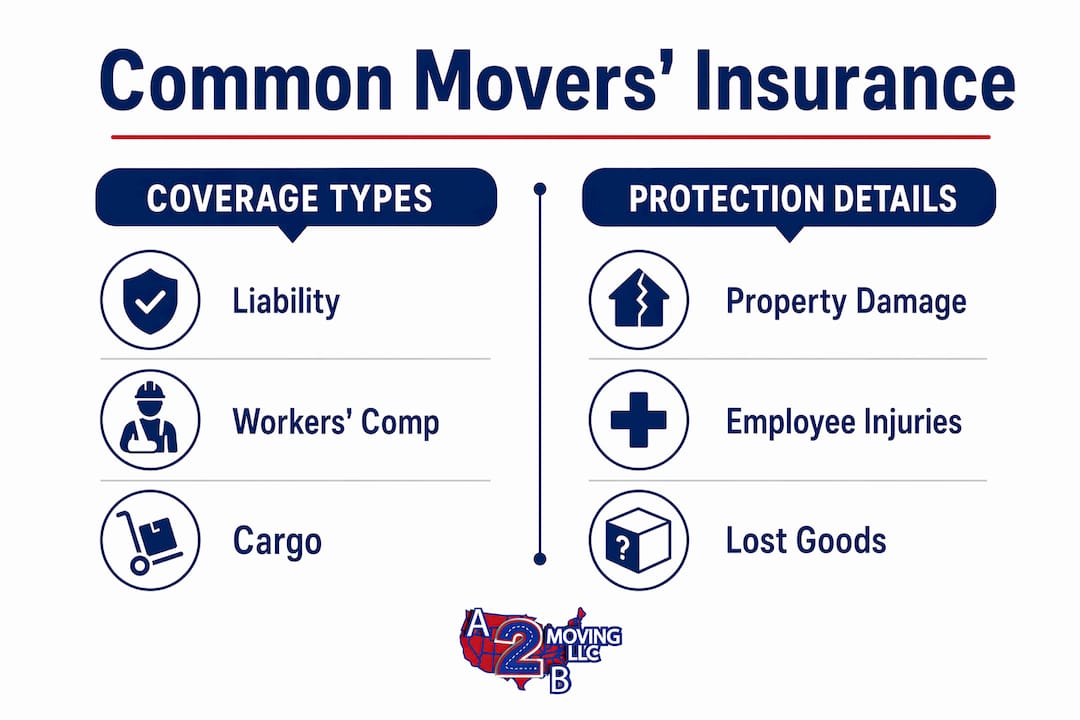
Workers' compensation matters more than most people realize. If a mover's employee is injured in your home and the company carries no workers' comp, you could face a liability claim. Always confirm it is listed on the COI.
How do you verify a mover's license and insurance?
The full verification process takes about 30 minutes using free public records. Here is the sequence.
-
Look up the USDOT number on FMCSA's Protect Your Move tool. Go to the FMCSA mover search and enter the company's legal name or USDOT number. Confirm the record shows "Authorized for HHG" (household goods), active insurance filings, and review any complaint history. A company with a USDOT number but no HHG authorization cannot legally move your belongings interstate.
-
For intrastate moves, use your state's mover-license lookup. Each state handles this differently. California uses the Bureau of Household Goods and Services; North Carolina uses the NC Utilities Commission; New York uses the Department of Transportation. Search "[your state] mover license lookup" to find the right portal. Confirm the company's legal name on the state record matches exactly what appears on your estimate.
-
Request and read the Certificate of Insurance. A COI is a one-page summary of the mover's active policies. Check: policy types listed (BIPD, cargo, workers' comp, general liability), coverage limits for each, the policy effective and expiration dates, and the named insured. The named insured on the COI must match the legal name on the FMCSA or state record and on your estimate. A mismatch is a serious red flag.
-
Confirm carrier or broker status. A broker arranges your move but does not perform it. If you are booking through a broker, get the assigned carrier's USDOT number and run a separate lookup on that carrier. Brokers can complicate claims and estimate transfers, so knowing exactly who will be handling your goods matters before pickup day.
Pro Tip: When you read a COI, focus on four things: the insurer's name (is it a recognized underwriter, not an obscure shell?), the policy expiration date (is it still active on your move date?), the coverage limits (do they meet the federal $750,000 BIPD minimum for interstate moves?), and whether the named insured matches the mover's legal entity name on all your documents.)
What valuation options must movers offer you?
Valuation is not insurance. Under FMCSA rules, valuation is the mover's contractual liability for your goods — a federal framework that sets how much the carrier owes you if something is lost or damaged. You must select a level in writing, and it must appear on your bill of lading before pickup.
Released Value Protection
This is the default option and costs nothing extra. The catch: the carrier's liability is capped at $0.60 per pound per article. A 10-pound laptop damaged in transit? The carrier owes you $6.00, regardless of what the laptop is worth. A 50-pound flat-screen TV? $30.00. For most households, Released Value Protection leaves a significant gap between what you could recover and what your belongings actually cost.
Statistic to know: Under Released Value Protection, a 10-pound item is covered for exactly $6.00 — $0.60 × 10 lbs — no matter its actual market value. (FMCSA valuation guide)
Full Value Protection
With Full Value Protection, the carrier is liable to repair the damaged item, replace it with a similar item, or pay you its current market value. This option typically costs extra, and carriers can set a minimum declared value for your shipment. For items of extraordinary value (over $100 per pound), you generally need to list them specifically in writing before the move or the carrier's liability for those items may be limited.
Side-by-side comparison
| Feature | Released Value Protection | Full Value Protection |
|---|---|---|
| Cost to you | Free | Additional charge (varies by carrier) |
| Carrier liability | $0.60/lb per article | Repair, replace, or pay market value |
| High-value item coverage | Minimal | Better, but requires specific listing |
| Typical exclusions | Acts of God, owner-packed items | Acts of God, items not listed at declared value |
| Third-party insurance advisable? | Yes, strongly | Yes, for high-value or irreplaceable items |
| Claims go to | Carrier (FMCSA framework) | Carrier (FMCSA framework) |
Always check your bill of lading before the truck leaves. If your chosen valuation is not written on that document, you have no written proof of what you elected.
When should you buy third-party moving insurance?
Carrier valuation, even Full Value Protection, has gaps. Perils like flooding, acts of God, or owner-packed boxes are typically excluded. Valuation and insurance are governed by different authorities — valuation claims go to the carrier under FMCSA rules, while third-party insurance claims go to a state-licensed insurer. They can run in parallel.
Third-party moving insurance makes the most sense when you are moving antiques, fine art, jewelry, electronics, or anything irreplaceable. It also makes sense if you are using Released Value Protection and cannot afford to absorb the gap.
Here is how to buy it:
- Check your homeowner's or renter's policy first. Some policies extend coverage to goods in transit. Call your insurer and ask specifically about moving coverage, exclusions, and deductibles before you pay for a separate policy.
- Request a written quote from a state-licensed moving insurer. Ask for an all-risk policy, which covers accidental damage, not just total loss.
- Compare exclusion lists carefully. Owner-packed boxes, mechanical breakdown, and pairs-and-sets clauses (where damaging one piece of a set limits recovery to that piece) are common exclusions. Read them before you sign.
- Declare your shipment's value accurately and get a written policy document. Undervaluing to save on premium can reduce your payout if you file a claim.
All-risk moving insurance typically runs roughly 1–2% of declared value as a premium. On a $50,000 shipment, that is $500–$1,000 for comprehensive coverage — often worth it for a household with significant valuables.
Pro Tip: Keep your insurance invoice and policy reference number in the same folder as your bill of lading and written estimate. If damage occurs, you can file with the carrier and the insurer simultaneously, and having both documents in one place speeds up both processes.
What red flags should make you walk away from a mover?
Most moving fraud follows predictable patterns. Knowing them in advance costs nothing.

Red flags in narrative form:
A mover that cannot produce a USDOT number or state license number on request is either unregistered or hiding something. No legitimate carrier hesitates to share this. Similarly, if a company's insurance is "not on file" at FMCSA or the state regulator, that is not a paperwork delay — it is a compliance failure that means you have no legal recourse if your goods are damaged.
Pressure for a large upfront cash deposit is another warning sign. Reputable movers typically collect payment at delivery, not before pickup. A company that demands 25–50% upfront before your goods are loaded has little incentive to handle them carefully. Trucks with no company branding, or a truck whose DOT number does not match the company you hired, suggest a subcontracted operation where accountability is murky.
Evasiveness about the COI is a tell. A compliant mover can produce a COI within 24 hours. If a company stalls, gives you a document with expired dates, or lists a different legal name than what is on your estimate, stop the process.
Script templates you can use when calling movers:
If a mover refuses any of these requests, that tells you everything. Pause, verify records independently, and be ready to look elsewhere.
How do moving claims work, and what documentation do you need?
Filing a successful claim starts at delivery, not after. Here is the sequence.
- Note damage on the delivery receipt before the movers leave. If you sign a clean receipt, you are accepting the shipment as delivered in good condition. Write specific damage descriptions on the receipt, even if the driver seems impatient.
- Photograph every damaged item immediately. Capture the item, the packaging it arrived in, and any visible impact points. Timestamps matter.
- Keep original packing materials. Carriers and insurers often require inspection of the original packaging to assess whether damage occurred in transit or was pre-existing.
- File a written claim with the mover within the carrier's stated deadline. For interstate moves, FMCSA requires carriers to acknowledge a claim within 30 days and settle or deny it within 120 days. Missing the carrier's own filing deadline can forfeit your right to recover.
- Escalate if needed. For interstate moves, unresolved claims can be reported to FMCSA. For third-party insurance claims, contact your state insurance commissioner if the insurer is unresponsive.
Documentation checklist:
- Bill of lading (your primary contract with the carrier)
- Written binding estimate
- COI or third-party insurance policy number and reference
- Photos of damaged items and original packaging
- Receipts or purchase records for damaged items
- Repair or replacement estimates from a third party
- Delivery receipt with damage noted at time of delivery
The carrier liability framework under FMCSA is separate from third-party insurance. You can file both claims simultaneously, and doing so is often the fastest path to full recovery.
What should a compliant mover actually provide? A2bmoving as an example
Knowing what to ask for is one thing. Knowing what a compliant mover should hand you without being asked is another.
A2bmoving, operating out of Wheeling, WV, illustrates what the paperwork and process should look like for a properly credentialed local mover. When you book, you should receive a written estimate that shows the company's legal name, license number, and contact information. The estimate itself should be binding, not a rough ballpark, and it should specify the services included. A2bmoving uses flat-rate pricing, which means the number on the estimate is the number you pay — no surprise fuel surcharges or stair fees added at delivery.
Before your move date, ask for the COI. A compliant mover provides it promptly, and the document should list active BIPD, cargo, and workers' compensation coverage with expiration dates that extend past your move date. A2bmoving's insured moving crews carry that coverage on every job, whether it is a local apartment move or a specialty piano relocation.
On move day, the bill of lading is your contract. It should show your name, origin and destination addresses, the agreed price, and your chosen valuation option. If any of those fields are blank when the driver hands it to you, fill them in or do not sign.
For residential moves in the Ohio Valley region, A2bmoving's process covers each of these steps. Customers can ask for the COI, confirm the flat-rate estimate in writing, and review the bill of lading before a single item is loaded.
Key Takeaways
Hiring licensed and insured movers requires confirming USDOT or state license status, active insurance filings, a written binding estimate, and your elected valuation option in writing before the move begins.
| Point | Details |
|---|---|
| Verify license before signing | Look up the USDOT number on FMCSA or the state mover-license portal; confirm "Authorized for HHG" for interstate moves. |
| Request a COI with active dates | The Certificate of Insurance must show BIPD, cargo, and workers' comp coverage with expiration dates past your move date. |
| Understand Released Value limits | At a fixed rate per pound per article, a 10-pound item recovers only a small amount — consider Full Value Protection or third-party insurance for valuables. |
| Elect valuation in writing | Your chosen valuation option must appear on the bill of lading before pickup; a blank field means no written proof. |
| A2bmoving's trust signals | A2bmoving provides flat-rate written estimates, COI on request, and insured crews for moves in the Wheeling, WV area. |
Buy third-party moving insurance when you are shipping high-value, antique, or irreplaceable items that exceed what carrier valuation can realistically cover.
Why licensing and insurance are the baseline, not a bonus
Most people shop for movers by price. That is understandable — moving is expensive. But price comparison only makes sense between movers who are actually compliant. An unlicensed mover quoting $400 less than a licensed one is not a deal; it is a transfer of risk from the mover to you. If your goods are damaged and the mover has no insurance on file, you have no legal mechanism to recover. You are not a customer at that point — you are an unsecured creditor hoping for goodwill.
At A2bmoving, the view is straightforward: licensing and insurance are not selling points, they are the floor. Every job starts with a written estimate, a COI available on request, and a crew that is covered. That is what accountability looks like in practice, not in a brochure. Homeowners and businesses both deserve to know exactly who is handling their property and what recourse exists if something goes wrong. The verification steps in this article take about 30 minutes and cost nothing. The cost of skipping them can be much higher.
A2bmoving offers licensed, insured local moving with flat-rate pricing
When you have done the verification work and you want a mover in the Wheeling, WV area that already checks every box, A2bmoving is ready. Licensed crews, COI on request, flat-rate written estimates with no hidden fees, and insured vehicles on every job. Whether you are moving a household, an apartment, a senior family member, or a commercial office, the process starts with a free estimate and a straight answer on price.
A2bmoving's moving services cover local and long-distance relocations within the Ohio Valley region, including packing services and specialty moves. Request your free estimate online at a2bmoving.info or call to speak with the team directly. You will get a binding quote, not a ballpark, before anything is scheduled.
Useful sources for verifying movers and understanding your rights
Save these links when you start requesting quotes. They are the primary official resources for confirming a mover's credentials and understanding your coverage options.
| Resource | What You Will Find There |
|---|---|
| FMCSA Protect Your Move — Mover Search | Operating authority status, insurance filings, complaint history for interstate movers |
| FMCSA HHG Mover Search Tool | Direct lookup by company name or USDOT number; carrier vs. broker status |
| FMCSA Valuation & Insurance Guide (PDF) | Released Value vs. Full Value Protection explained; your rights under federal rules |
| FMCSA Steps to Select a Mover | Step-by-step consumer guidance from the federal regulator |
| MoverScorecard — How to Vet a Long-Distance Mover | Practical vetting checklist; carrier vs. broker guidance |
| MovingRated — Moving Insurance Guide | Third-party moving insurance explained; state-regulated products |
| FreightWaves — Valuation Coverage in Moving | Valuation vs. insurance distinction; premium guidance for all-risk policies |
| State PUC / DOT mover license portals | Intrastate mover license verification (search "[your state] mover license lookup") |
For a deeper look at how carrier liability fits into the broader freight lifecycle, FreightSuite's guide covers the contractual and operational dimensions that apply to commercial moves as well.
FAQ
Do movers need to be licensed and insured?
Yes. All for-hire moving companies operating in interstate commerce must be licensed and insured with FMCSA. For intrastate moves, state law governs licensing requirements, which vary by state.
How do you tell if a moving company is insured?
Request the company's Certificate of Insurance and cross-check it against their FMCSA record or state mover-license record. The named insured on the COI must match the legal name on all your documents, and the policy expiration dates must extend past your move date.
How much does it cost to hire movers for a few hours?
Hourly rates for local moves vary by market, crew size, and services included. A2bmoving uses flat-rate pricing rather than hourly billing, so the estimate you receive before the move is the price you pay. Contact A2bmoving directly for a free quote specific to your move.
Is it worth getting moving insurance?
If you are relying on Released Value Protection, the default carrier option, the answer is almost always yes for anything of real value. At $0.60 per pound per article, a damaged 10-pound item recovers only $6.00. Third-party all-risk moving insurance typically costs roughly 1–2% of declared value and covers perils that carrier valuation excludes.
What is the difference between valuation and moving insurance?
Valuation is the mover's contractual liability under FMCSA rules — it is not an insurance policy. Third-party moving insurance is a separate, state-regulated product sold by licensed insurers. Claims for valuation go to the carrier; claims for third-party insurance go to the insurer. You can file both simultaneously if damage occurs.